Description
eplt Notes:
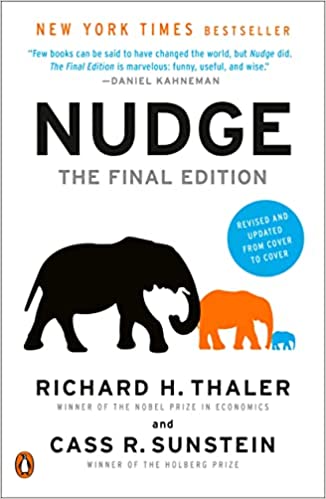
“Nudge” is a book written by Richard H. Thaler and Cass R. Sunstein, published in 2008. The book explores the concept of “choice architecture” and how it can be used to influence people’s behavior towards making better decisions. Can also read Priceless, less academic.
The authors argue that people are not always rational decision-makers, and that small changes in the way choices are presented can have a big impact on the decisions people make. They call these small changes “nudges.”
The key points of the book include:
- Choice architecture matters: The way choices are presented to people can influence their decisions. Small changes in the way choices are presented can lead to big changes in behavior.
- People are not always rational decision-makers: Human beings are prone to cognitive biases, such as overconfidence, present bias, and status quo bias. These biases can lead people to make decisions that are not in their best interests.
- Nudges can help people make better decisions: Nudges are small changes in the choice architecture that can help people overcome their cognitive biases and make better decisions. Examples of nudges include default options, social norms, and feedback.
- Nudges are not coercive: Nudges are different from mandates or regulations because they do not limit people’s choices. Instead, nudges help people make better choices by presenting options in a way that is more likely to lead to a desirable outcome.
- Nudges can be used for social good: Nudges can be used to promote behaviors that are beneficial to individuals and society as a whole, such as saving for retirement, reducing energy consumption, and increasing organ donation rates.
The book “Nudge: Improving Decisions About Health, Wealth, and Happiness” by Richard H. Thaler and Cass R. Sunstein presents a compelling case for libertarian paternalism, an approach that seeks to influence people’s behavior in a way that makes their lives better while still maintaining their freedom of choice. The core thesis of the book is that small changes in the context can have a significant impact on people’s behavior, and that by understanding how people make decisions, policymakers and individuals can design environments that “nudge” people toward better choices.
The major structural arc of the book develops through several key concepts, including choice architecture, libertarian paternalism, and the distinction between Econs (rational decision-makers) and Humans (prone to biases and blunders). The authors argue that there is no such thing as a “neutral” design and that every choice architect has the responsibility for organizing the context in which people make decisions. They also identify a false assumption and two misconceptions that underlie the opposition to paternalism, including the idea that almost all people make choices that are in their best interest.
The book highlights several significant conclusions, including the importance of understanding human fallibility in decision-making, the role of social influences on behavior, and the need for well-designed choice architecture. The authors provide numerous examples and anecdotes to illustrate these points, from the design of cafeteria menus to the presentation of investment options in retirement plans. They also discuss various strategies for improving decision-making, including the use of defaults, simplification of complex choices, and provision of clear feedback.
Some key takeaways from the book include:
- Small changes in the context can have a significant impact on people’s behavior.
- There is no such thing as a “neutral” design, and every choice architect has the responsibility for organizing the context in which people make decisions.
- Libertarian paternalism is a relatively weak, soft, and nonintrusive type of paternalism that aims to influence people’s behavior in order to make their lives longer, healthier, and better.
- Real people are prone to biases and blunders, and this has implications for how we design policies and institutions.
Overall, the book presents a nuanced and thoughtful exploration of the ways in which choice architecture can be used to improve decision-making outcomes. By understanding the psychological biases and limitations that influence individual behavior, policymakers and individuals can create environments that nudge people toward more optimal choices, ultimately leading to improved financial outcomes, better health, and increased happiness.
The book’s tone is informative, engaging, and slightly humorous, making complex concepts accessible to a wide range of readers. The authors use anecdotes and examples to illustrate key points, adding nuance and depth to their arguments. The text conveys a sense of empathy for individuals struggling with complex decisions, while also emphasizing the importance of responsible choice architecture.
In conclusion, “Nudge: Improving Decisions About Health, Wealth, and Happiness” is a thought-provoking book that challenges readers to think critically about the ways in which choice architecture can be used to improve decision-making outcomes. By providing a comprehensive overview of the key concepts and strategies presented in the book, this executive summary aims to distill the main arguments and takeaways into a clear and concise format.
- Publisher : Penguin Books; Revised edition (August 3, 2021)
- Language : English
- Paperback : 384 pages
- ISBN-10 : 014313700X
- ISBN-13 : 978-0143137009
- Item Weight : 12.6 ounces
- Dimensions : 5.45 x 0.83 x 8.29 inches


Reviews
There are no reviews yet.