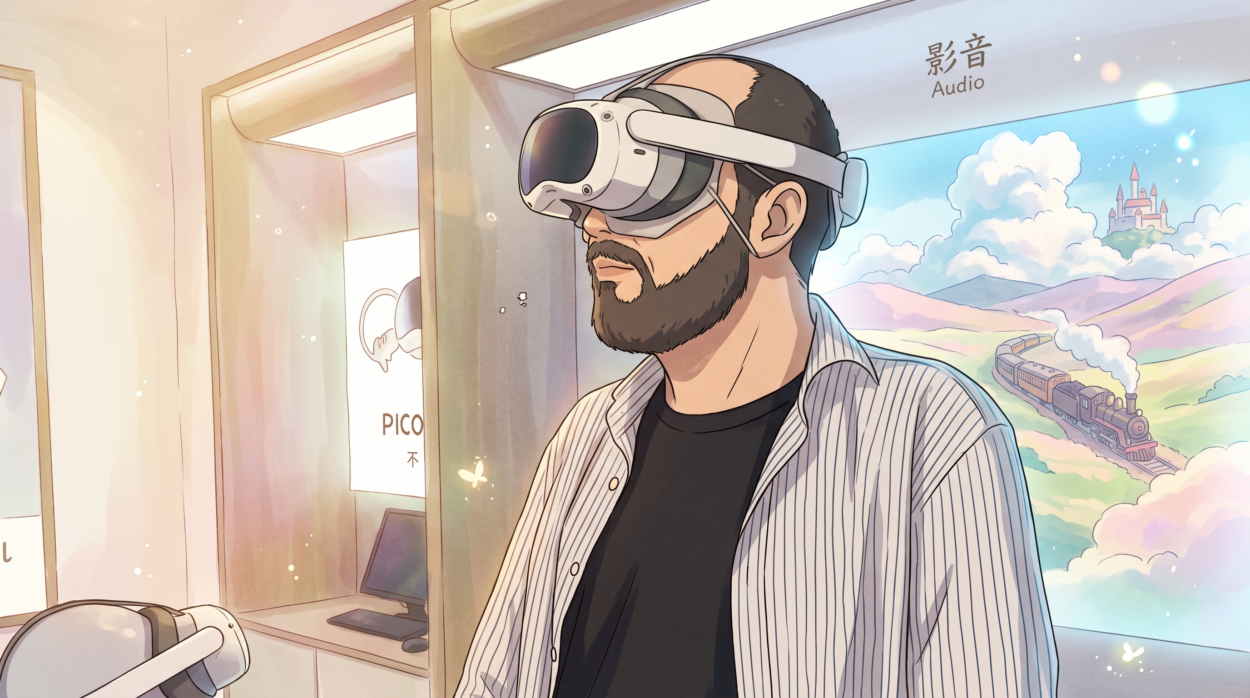
I’ve been a big fan of the PICO 4 series for several years. I’ve owned the original PICO 4, the PICO 4 Pro and the PICO 4 Ultra, and I’ve had a good experience with all three.
They fit the way I use XR. For me, a headset is primarily an entertainment device: I use it to watch immersive videos, play games and connect wirelessly to my PC through Virtual Desktop. I appreciate advanced technology, but I don’t necessarily need to wear a complete computer on my face every time I want to enjoy VR.
Trying the Apple Vision Pro
I’ve also had the opportunity to spend some time trying the Apple Vision Pro through a friend. It was clearly a more advanced machine, particularly when it came to display quality, software integration and passthrough.
The view of the real world appeared slightly darker to me—almost like looking through a pair of lightly tinted sunglasses—but otherwise the passthrough was remarkably convincing. I noticed very little delay, and the pixel quality was good enough that there was no immediately distracting distortion. It felt natural and seamless in a way that the PICO 4 series cannot currently match.
The Vision Pro is undoubtedly the more capable spatial-computing device. Its image quality is significantly higher than that of the PICO 4, and the overall experience is extremely polished. But it is also heavier and belongs to a completely different price category.
For the way I use XR, I couldn’t justify paying several times the price of a PICO headset. I don’t need all that computing power for watching videos, playing games and using Virtual Desktop. The Vision Pro impressed me, but it also confirmed that the lighter and more affordable PICO approach was a better fit for me.
Why I Stayed with PICO
One of the greatest strengths of the PICO 4 range has always been its balance. The headsets offer solid visual quality, good performance and a comfortable design without pushing the price into premium-computer territory.
The PICO 4 was also the headset that made me truly appreciate pancake lenses. Compared with the Fresnel lenses found in many older VR headsets, pancake optics provide a much clearer and more comfortable experience for me.
My eyes can easily pick up the concentric rings in Fresnel lenses, which can be distracting and reduce the feeling of immersion. Pancake lenses provide a cleaner image across a larger usable area, so I don’t feel as though I constantly need to adjust the headset to find a tiny sweet spot. After getting used to the PICO 4, I’ve found it difficult to return to Fresnel-based headsets.
PICO’s headsets may not offer the same premium experience as the Vision Pro, but they deliver the features I actually use in a lighter and considerably less expensive package. That combination of price, comfort and performance is what has kept me with the brand.
Enter the PICO Space Pro
With that background, I’ve been eagerly waiting for PICO’s next-generation flagship: the PICO Space Pro, previously known as Project Swan.
The early specifications suggest this could be a substantial step forward. PICO has announced dual 4K-class Micro-OLED displays with a pixel density of approximately 4,000 PPI. The company is claiming an average angular resolution of around 40 pixels per degree, rising above 45 PPD in the centre of the field of view.
Those numbers are especially exciting to me. Higher resolution and greater pixel density should improve far more than games. They could make text easier to read, videos more detailed and virtual desktop applications more practical. Micro-OLED technology should also deliver better contrast and deeper black levels than the LCD displays used in the PICO 4 range.
The Space Pro will use a dual-chip architecture, combining a flagship main processor with custom PICO silicon dedicated to spatial perception and image processing. PICO says the main processor will provide more than twice the CPU and GPU performance of the Snapdragon XR2 Gen 2, while the dedicated XR chip will help achieve mixed-reality perception latency of approximately 12 milliseconds.
If those claims translate into real-world performance, the Space Pro could address one of the biggest differences I noticed when comparing the PICO 4 with the Vision Pro: the quality and responsiveness of mixed-reality passthrough.
A New Spatial Operating System
Hardware is only part of the story. The Space Pro will run PICO OS 6, which introduces a new spatial engine designed to bring conventional Android apps, 3D applications, immersive content and the physical world into one shared environment.
That could move PICO beyond being primarily an entertainment-focused VR platform. At the same time, I hope the company doesn’t lose sight of the straightforward experiences that made the PICO 4 so enjoyable.
I still want excellent video playback, reliable wireless PC VR, comfortable controllers and easy access to games. More advanced spatial-computing features would be welcome, but they should add to those strengths rather than replace them.
Delayed Until Q4 2026
PICO had planned a Space Pro event for September 2, 2026, but it has now moved the release into the fourth quarter of the year. According to the company, the extra time is needed for a major upgrade to the software experience and additional testing.
Naturally, I’m slightly disappointed. I’ve already been waiting well over a year for PICO’s next major headset, and I was looking forward to learning the final specifications, price and availability.
However, a delay of a few more months is not a deal-breaker for me. A new headset can have excellent hardware and still be let down by unfinished software. If PICO genuinely uses this time to improve stability, compatibility and the overall user experience, waiting may be the right decision.
Price Will Be the Deciding Factor
There are still some important unknowns. One of the most interesting rumours is that the PICO Space Pro could weigh around 270 grams, with the battery moved into a separate tethered module. For comparison, the PICO 4 Ultra weighs approximately 580 grams in total. On paper, the reported Space Pro figure is around 310 grams—or 53%—lower than the total weight of the PICO 4 Ultra.
However, this is not a perfect like-for-like comparison. The rumoured Space Pro figure may exclude its external battery and possibly other components, while the PICO 4 Ultra’s quoted weight includes its built-in battery and complete head strap. PICO has not yet officially confirmed the Space Pro’s final weight or precisely what the 270-gram figure includes.
The price will probably be the deciding factor for me. Unconfirmed reports have suggested a figure of around US$2,000 or possibly more, but I remain sceptical of those estimates. A price at that level would place the Space Pro in a very different category from previous PICO 4 headsets.
I don’t expect technology of this level to be as inexpensive as the original PICO 4. Nevertheless, affordability has always been one of PICO’s biggest attractions. I hope the company can find a sensible balance between delivering premium hardware and keeping the headset within reach of existing PICO users.
If the price is reasonable, the PICO Space Pro will be high on my list. The combination of Micro-OLED displays, greater processing power, improved mixed reality and a new spatial operating system sounds like a meaningful upgrade—not simply another minor refresh.
For now, I’ll be following the announcements closely and waiting for the final details. The delay is disappointing, but I would rather see PICO take the time to release a polished product.
After owning three PICO headsets, I’m ready to see what comes next. The PICO Space Pro might be the XR upgrade I’ve been waiting for.
References
- Spatial Insider — “PICO Space Pro Launch Delayed to Q4 2026 for Major Software Upgrade”
https://spatialinsiders.com/stories/pico-space-pro-launch-delayed-q4-2026 - Road to VR — “Pico’s Vision Pro Competitor Delayed Amid Cancelled Launch Event”
https://roadtovr.com/pico-vision-pro-competitor-delayed-cancelled-event/ - VR Expert — “PICO Space Pro: Project Swan Gets an Official Name and September 2 China Launch Event”
https://vr-expert.com/en-us/news/pico-space-pro-project-swan-gets-an-official-name-and-september-2-china-launch-event-2/ - VR.org — “Pico Moves Space Pro to Q4 and Cancels Its September 2 Event”
https://vr.org/articles/pico-space-pro-delayed-q4-september-event-cancelled-2026 - Reddit / r/PicoXR — “A Brief Update About PICO Space Pro”
https://www.reddit.com/r/PicoXR/comments/1w11b67/a_brief_update_about_pico_space_pro/

Leave a Comment